
Why Rest During a Workout Can Actually Help You Get Stronger
If the fitness industry has a love language, it might be “keep moving.”
More sweat. Less rest. Faster transitions. Higher heart rates. Constant motion.
Somewhere along the way, a lot of people were taught to believe that resting during a workout is a sign of weakness — like taking a break means you are losing ground, falling behind, or not working hard enough.
At Fitness Lying Down in La Crosse, Wisconsin, we see it differently.
We believe that rest is one of the most valuable tools in a strength training program. Not because we want people doing less, but because we want them doing better.
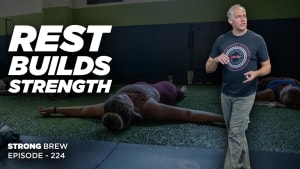
In this episode of Strong Brew, we break down why rest is not the enemy of results. In fact, when programmed well, rest can improve movement quality, support recovery, and help you build more meaningful strength.
The Fitness Industry Often Gets Rest Wrong
A lot of workout programs are built around the idea that more work automatically means a better workout. If you are constantly moving, constantly pushing, and constantly chasing fatigue, then it must be effective… right?
Not necessarily.
When the body is under continuous stress without enough recovery, things start to change — and not for the better. Breathing gets rushed. Muscles tighten up. Movement becomes less precise. Technique starts to break down. What began as a focused strength session can quickly turn into survival mode.
That may feel intense, but intensity alone does not guarantee progress.
If your goal is to improve strength, movement quality, and long-term resilience, then your workout needs more than effort. It needs balance.
Why Rest Matters in Strength Training
Strength training is not just about doing work. It is about doing the right work with enough quality that your body can actually adapt to it.
That means using the proper load, applying effort with intention, and giving yourself enough recovery between exercises or stations so that you can perform the next round with focus and control.
When rest is built into a workout, several important things happen:
- Technique improves because you are not trying to force quality movement through excessive fatigue.
- Strength output improves because you are fresher and more prepared for the next effort.
- Breathing normalizes so you can regain composure and improve readiness.
- Unnecessary tension decreases so you do not enter each exercise feeling tight and rigid.
- Recovery begins inside the session, not just after it ends.
That last point matters more than most people realize.
Your post-workout recovery can actually be improved by better recovery during the workout itself. When you balance effort with intentional rest, you create a more productive training environment for your nervous system, your muscles, and your overall movement quality.
Rest Is Not Lazy. Rest Is Strategic.
At FLD, we do not look at rest as dead time. We look at it as preparation time.
In our group training sessions, that often means scheduling clear work-to-rest ratios within circuits. Sometimes that looks like a one-to-one relationship: 30 seconds of work followed by 30 seconds of rest. Other times, the set itself may move faster, but we create larger breaks between stations or rounds to make sure the session still has enough room for recovery.
The goal is not to make things easy. The goal is to make things effective.
We want clients ready to attack the next exercise with purpose — not simply limp into it because the clock told them to keep moving.
That is a huge difference.
Why Constant Motion Can Hold People Back
There is a big difference between training and just staying busy.
If someone is moving nonstop for 20 to 30 minutes with little room to recover, it becomes much harder to use the loads necessary for building strength. It also becomes harder to maintain quality mechanics, especially as fatigue starts to pile up.
That is one of the reasons why “burn as many calories as possible” is not the standard we chase at Fitness Lying Down.
We are not interested in mindless movement for the sake of looking busy.
We are interested in helping people:
- Get stronger
- Move better
- Reduce unnecessary wear and tear
- Build confidence in their bodies
- Create training habits they can sustain
Sometimes the smartest thing you can do for your progress is pause, breathe, shake things out, and prepare for the next effort.
Rest in Personal Training Looks Different — But It Still Matters
In semi-private and personal training, rest may not always follow the same timed circuit structure as group training. There is often more flexibility with sets and reps, and clients can move at a pace that better matches their readiness and needs.
But that does not mean recovery disappears.
It just becomes more individualized.
At FLD, we also use Myofascial Integrated Movement (MIM) strategies inside personal training sessions to help clients soften excess tension, reset their breathing, and stay connected to quality movement while still making progress.
These are not throwaway filler drills. They are purposeful opportunities to support the body while still reinforcing movement strength, awareness, and control.
In other words, even the “breaks” can still work for you.
Better Recovery Leads to Better Performance
One of the biggest takeaways from this episode is simple:
The better you recover inside the session, the better you can perform during the session.
And the better you perform during the session, the more likely it is that your workout actually moves you toward your goals.
This matters whether your goal is to:
- Build strength
- Improve mobility
- Increase stability
- Move with less pain
- Feel more capable in everyday life
Rest supports all of it.
Not because rest does the work for you, but because rest helps you bring your best self to the work that matters most.
Stop Feeling Guilty for Taking a Breath
If you have been conditioned to think that every second of a workout needs to feel breathless, frantic, or punishing, this is your reminder:
You do not have to earn results by running yourself into the ground.
Sometimes real progress looks like slowing down just enough to do the next rep better.
Sometimes it looks like taking the break, loosening the shoulders, calming the breath, and stepping back into the next movement with precision.
Sometimes it looks like training in a space that respects both effort and recovery.
That is what we aim to deliver at Fitness Lying Down.
Train Smarter at Fitness Lying Down in La Crosse
If you are tired of workouts that leave you exhausted but not actually improving, we would love to help.
At Fitness Lying Down, our programs are designed to help adults build strength, improve movement, and train with more purpose. That includes smart programming, intentional coaching, and recovery strategies that support real results.
Whether you are brand new to strength training or looking for a better long-term fit, our coaching meets you where you are and helps you move forward with confidence.
Learn more about Fitness Lying Down here.
Watch the Full Strong Brew Episode
Check out the full episode below to hear why rest is not weakness — and why better recovery during your workout may be one of the missing links to better results.
Ready to experience strength training with purpose?
Check out our 2-Week Immersion and get started today.