
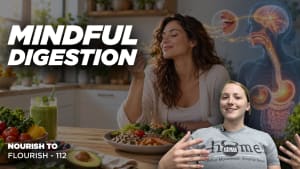
You Don't Just Eat With Your Stomach: Why Chewing Matters for Digestion
When we think about digestion, most of us picture something pretty simple: food goes into the stomach, gets broken down, nutrients get absorbed, and we're on our way.
But digestion actually starts before your food ever reaches your stomach.
In Episode 112 of Nourish to Flourish, Megan the Trainer RD explains why the experience of eating—including seeing, smelling, tasting, and chewing your food—plays an important role in digestion, fullness, satisfaction, and even how much we eat.
Digestion Starts Before Food Reaches Your Stomach
Your mouth isn't simply a doorway to your digestive tract. It's actually part of your digestive tract.
Before you've swallowed a single bite, your body is already responding to your meal.
Thinking about food, seeing it, smelling it, tasting it, and chewing it are all part of what helps tell your body:
"Hey, food's coming. Get ready."
That early response helps get saliva involved and begins preparing processes farther down the digestive tract, including stomach acid and digestive enzymes.
In other words, eating is more than simply delivering nutrients to your stomach.
Why Chewing Your Food Matters
We've all had those meals.
You sit down hungry, start eating, and seemingly 30 seconds later you're staring at an empty plate wondering what happened.
Or maybe breakfast is a smoothie or protein shake that disappears while you're driving out the door.
There's nothing inherently wrong with smoothies or protein shakes. As Megan points out, they can be convenient ways to get a variety of foods and nutrients into your day.
But when a meal becomes something you can finish in seconds, you can also remove a large part of the eating experience.
Chewing begins physically breaking food down before it travels farther through the digestive system. But chewing may also play a role in satiety, hunger and fullness signals, and meal satisfaction.
No, You Don't Need to Count Your Chews
If you've ever heard advice telling you to chew every bite exactly 30 or 32 times, don't worry.
That's not what Megan is asking you to do.
The goal isn't to turn dinner into a math problem.
Instead, consider simply slowing down enough to actually taste, chew, and experience your food.
That sensory experience gives your brain information about the meal you're eating and gives your body more time to participate in the process.
Eating More Slowly May Help You Feel More Satisfied
Nutrition isn't only about the nutrients sitting on your plate.
There is also value in the experience of eating them.
When you're constantly rushed, barely chewing, or not really tasting your food, you may be missing some of the signals that contribute to satisfaction and fullness.
That's particularly worth considering if weight management is one of your goals.
Slowing down doesn't mean following another restrictive food rule. It may simply mean giving yourself enough time to recognize the experience of eating and how your body responds to it.
Do You Have to Give Up Smoothies and Protein Shakes?
Absolutely not.
Smoothies and protein shakes can be useful, convenient tools—especially when life gets busy.
The bigger question is whether most of your meals require very little chewing or can be consumed extremely quickly.
If you're regularly choosing something with a smoothie-like texture, Megan suggests considering pairing it with something you can chew or making sure you're also including meals throughout the day that allow you to experience the benefits of actually eating your food.
Better Nutrition Doesn't Always Mean Doing More
We tend to make nutrition complicated.
More rules. More tracking. More numbers. More things to eliminate.
But sometimes one of the most useful things we can do is return to something incredibly basic:
Sit down. Slow down. Chew your food. Taste it. Enjoy it.
You don't need to count every chew.
You don't have to eliminate smoothies.
You don't need another complicated nutrition strategy.
Simply give your body a chance to participate in the meal instead of only receiving it once it arrives.
As Megan reminds us, sometimes it's the simple things that add up—and getting back to basics can be where the magic happens.
Want to Build a Nutrition Approach That Actually Works for You?
Nutrition coaching doesn't have to mean being handed another diet, tracking every bite you eat, or creating a list of foods that are suddenly off-limits.
A Nutrition Blueprint session with Megan the Trainer RD gives you an opportunity to look at your current habits, your goals, and where a few simple changes could make a meaningful difference.
Learn More About Nutrition Coaching
Now that you know better, let's go out and do better, so we can all be better.
Looking for more practical nutrition tips? Follow Nourish to Flourish with Megan the Trainer RD for realistic conversations about healthy eating, mindful eating, digestion, weight management, and building nutrition habits that work in real life.