One of the Most Misunderstood Words in Fitness
There are certain words you hear all the time in the fitness world.
Personal trainers use them. Fitness influencers use them. We use them with our clients at Fitness Lying Down in La Crosse, WI.
But sometimes we use a word so often that we forget to ask a pretty important question:
What does it actually mean?
There's one particular word we use constantly at FLD. We talk about finding it through your feet. We talk about creating it through your core. You'll hear it when we're squatting, lunging, pressing, pulling and especially when we're working from different body positions.
And people often assume it means the same thing as balance.
It doesn't.
So...What's the Mystery Word?
Stability.
Stability and balance are certainly related, but they aren't interchangeable.
One of the simplest ways we can define stability is:
Stability is preventing unwanted motion in one part of the body so we can allow purposeful motion somewhere else.
That distinction matters because strength training isn't simply about how much weight you can lift or how much movement you can create.
Sometimes becoming stronger means becoming better at preventing movement where we don't want it.
Stability vs. Balance: What's the Difference?
If you're standing with both feet firmly on the ground, you've already created a relatively stable foundation. You don't necessarily have to think about balancing because both feet are interacting with the ground and helping support you.
But change the position.
Move into a split stance. Try a sprinter stance. Start marching. Pick one foot off the floor. Perform a single-leg exercise.
Suddenly the demands placed on your body change dramatically.
Balance requires stability.
But stability doesn't always require balance.
That's an important difference when we're designing strength training and personal training programs for our clients.
Your Feet Have a Bigger Job Than You Think
At Fitness Lying Down, you'll frequently hear our coaches tell clients to “find your feet.”
There's a reason for that.
Your feet provide the foundation for everything happening above them. If your foot can't create a stable connection with the ground, unwanted motion can begin there and influence what happens farther up the body.
The rest of your body may have to find another strategy to complete the movement.
That's one reason we care so much about foot stability, body awareness and creating better connections from the ground up.
It's also why something as simple as footwear can influence what you're feeling. A very soft or cushioned surface underneath your foot may make it more difficult to create the solid foundation we're looking for during certain strength exercises.
What Does a “Stable Core” Actually Mean?
Core stability might be an even bigger fitness buzzword.
Everyone wants a “strong core.”
But having a strong core isn't necessarily about doing more crunches or trying to make your abs burn.
Think again about our definition of stability: preventing unwanted motion in one area so another area can move.
If you're pressing something overhead, for example, we want movement to occur through the appropriate areas while your core helps prevent unwanted arching, folding or excessive side-to-side movement.
When the core provides that stable platform, your shoulders and hips have a better opportunity to do their jobs.
That carries over into virtually every major movement pattern we train:
- Squatting
- Hinging
- Lunging
- Pushing
- Pulling
- Rotating and resisting rotation
- Walking, marching and single-leg movement
That's why functional core training at FLD looks very different from simply doing abdominal exercises.
Are You Balancing...or Just Surviving?
Standing on one leg doesn't automatically mean you're effectively training balance.
If you pick up one foot and your entire body starts moving around like a little sapling in a windstorm, you're certainly working hard.
But you might be doing more surviving than balancing.
Instead, imagine creating a solid connection through the foot, controlling the position of the body and then maintaining that position.
Now we have a foundation.
From there, we can increase the challenge by adding purposeful movement—maybe an overhead press, a row or another task—while maintaining that stability.
That's where balance training, core stability and functional strength begin working together.
Strength Is About More Than Creating Motion
This is one of the reasons our approach to personal training at Fitness Lying Down isn't built around simply making exercises harder for the sake of making them harder.
We want to create an environment where you can learn how your body works together.
Can your feet create a strong connection with the ground?
Can your core resist unwanted motion?
Can your shoulders and hips move while the rest of your body provides the stability they need?
Can you maintain those connections as we change positions, loads, directions and movement patterns?
Those connections are a big part of what we mean when we talk about training the body from nose to toes.
Because sometimes getting stronger isn't about producing more movement.
It's about becoming better at controlling the movement you already have.
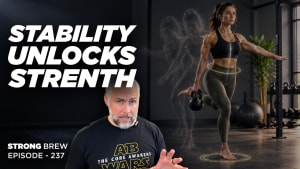
Watch Strong Brew Episode 237
Want to see what all of this looks like in action?
In Strong Brew Episode 237, Cory breaks down stability, balance, foot stability and core stability—and explains why understanding the difference can change the way you think about strength training.
Looking for Personal Training in La Crosse, WI?
At Fitness Lying Down, our approach to strength training goes beyond simply counting reps and adding weight. We help our clients understand how their bodies create connections, control movement and build strength that carries over into life outside the gym.
Whether you're looking for personal training, semi-private personal training, functional strength training, core training or a gym in La Crosse, Wisconsin where you can learn to move and feel stronger without the egos or intimidation, we'd love to introduce you to the FLD approach.
Better connections. Better movement. More strength—from your nose to your toes.