Born to Squat: Are We Sacrificing Mobility for Strength?
Strong Brew Episode 238 | Fitness Lying Down | La Crosse, WI
CRIPES! Have we been training squats all wrong?
It's Squatober, and that means we're celebrating one of the most recognizable movements in fitness: the squat!
But somewhere along the way, we may have started confusing the purpose of the squat with how much weight we can lift while performing it.
At Fitness Lying Down in La Crosse, Wisconsin, we believe understanding human movement patterns is essential to building strength, improving mobility, and creating a body that moves better both inside and outside the gym.
And that brings us to a question worth asking: Are we actually improving our squat, or simply making it heavier?
Squatting Is a Movement Pattern, Not Just an Exercise
When most people hear the word "squat," they immediately picture someone in a gym with a heavily loaded barbell across their shoulders.
But the squat existed long before barbells, kettlebells, and weight rooms.
Squatting is a fundamental human movement pattern. In fact, in many cultures, a deep squat is commonly used as a resting position rather than an exercise.
Imagine walking through downtown La Crosse and seeing people comfortably resting in a deep squat along the sidewalk. Not exactly something we see every day!
"The squat is a human movement pattern, so it's not an exercise, per se."
We use exercises to train the squat pattern, but that doesn't mean we should lose sight of what the movement itself requires: mobility and usable range of motion.
Squat vs. Hip Hinge: Understanding the Difference
One of the important distinctions we discuss in this episode is the difference between a squat pattern and a hip hinge pattern.
While the squat is primarily a mobility-oriented movement pattern, the hip hinge is a fundamental lifting pattern.
Think about picking something heavy up from the floor. A properly executed hip hinge allows the hips to move backward while the body organizes itself to manage the load.
Deadlifts are a familiar example of an exercise that trains this pattern.
Squats and hinges both have important roles in strength training, but understanding their different purposes can help us make better decisions about how we train them.
And don't worry, we'll save more of our hip hinge conversations for November. Right now, it's Squatober!
When More Weight Means Less Movement
There's nothing inherently wrong with loading a squat. In fact, adding resistance can be extremely beneficial.
The problem begins when the amount of weight we're using interferes with our ability to move through the range of motion we're trying to develop.
When the nervous system perceives a load as more than it can comfortably manage, the body may begin limiting movement or creating compensations to complete the exercise.
"If that weight is too much for your brain to comprehend and to navigate through, it's going to start putting the brakes on your range of motion."
Think about that for a moment.
If we're constantly sacrificing squat depth to accommodate heavier weights, are we truly developing the movement pattern?
Or are we simply becoming better at moving heavier weights through a smaller range of motion?
More weight doesn't automatically mean better movement.
Why Bodyweight Squats Aren't Always the Answer
Here's where our approach to functional strength training might surprise some people.
If excessive loading can interfere with squat mobility, wouldn't removing the weight entirely solve the problem?
Not necessarily!
In some situations, an appropriately positioned external load can actually help someone organize their body and perform a better squat.
That's why we regularly incorporate exercises such as:
- Kettlebell Goblet Squats: Holding a kettlebell in front of the body can help create core stability and support a comfortable range of motion.
- DVRT Ultimate Sandbag Press-Out Squats: Using the Ultimate Sandbag during a press-out squat provides a different way to challenge core stability while reinforcing the squat pattern.
These exercises aren't simply about making squats more challenging. They're opportunities to create the right amount of stability and resistance so the body can move more effectively.
That's one of the principles behind our approach to DVRT (Dynamic Variable Resistance Training) at Fitness Lying Down.
Honor the Movement Before You Increase the Load
Whether you're new to strength training, returning to exercise, or have been working out for decades, it's worth remembering that every exercise should serve a purpose.
When we're training the squat, that purpose includes maintaining and improving the mobility that makes the movement so valuable.
"I do want to use load, but I have to have the right amount of load that I can keep that pattern authentic."
That doesn't mean abandoning heavy squats or avoiding challenging strength exercises.
It means selecting an appropriate load, recognizing how your body responds, and making sure the exercise supports the movement rather than working against it.
Because strength and mobility shouldn't have to compete with one another.
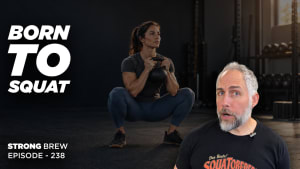
Watch Strong Brew Episode 238: Born to Squat
Join us for this Squatober edition of Strong Brew as we discuss squat mobility, hip hinging, appropriate loading, kettlebell goblet squats, and how to approach strength training with greater intention.
Looking for Personal Training in La Crosse, WI?
At Fitness Lying Down, we take a different approach to strength training.
Our small group and semi-private personal training sessions focus on helping people develop strength, mobility, stability, and confidence through intentional movement.
Whether you're looking to improve your squat, become stronger for everyday activities, or find a supportive gym environment without egos or intimidation, we'd love to introduce you to the FLD experience.
Learn more about our training opportunities and how to get started:
🔎 EAGLE EYES WANTED! 👀
CRIPES! We've got a little Squatober Easter egg for you!
Somewhere in Episode 238, an exercise sneaks onto the screen that doesn't quite belong with what we're discussing.
Can you spot the odd one out?
Watch closely, put your movement-pattern knowledge to the test, and let us know what you find!
Head over to YouTube and drop your answer in the comments. We want to see who's paying attention! 👇
Until next time, Happy Squatting! ☕️💪